Wednesday, April 5 2018
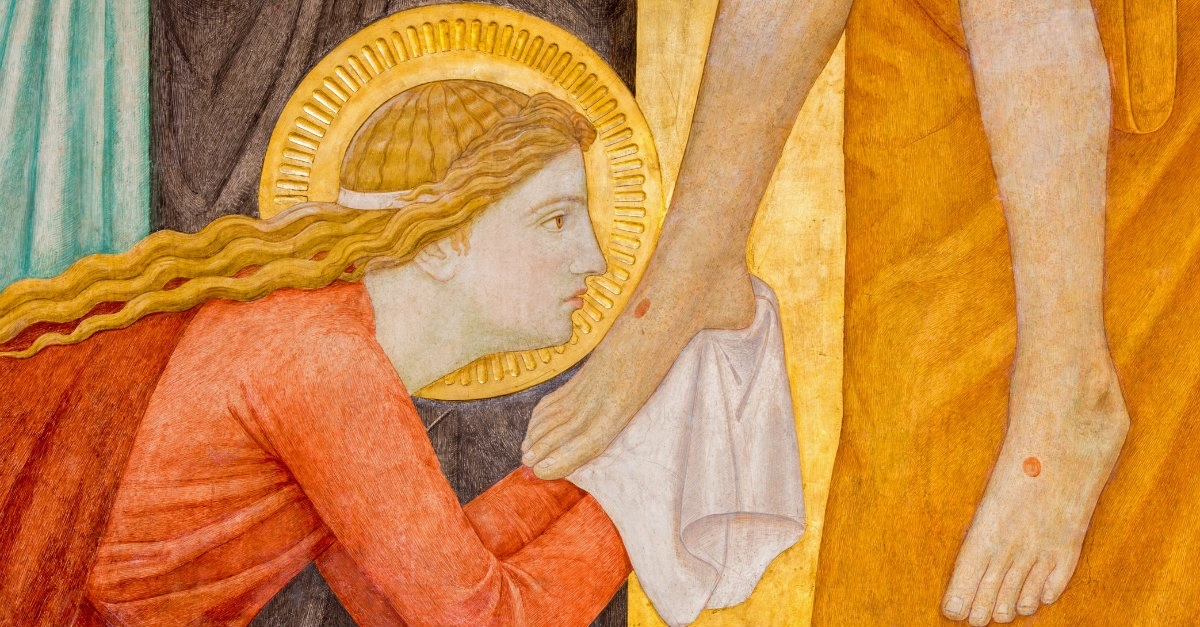
On Sunday, we heard the story of the Resurrection. We heard how the male disciples fled upon finding the empty tomb, but how Mary Magdalene stayed, and how she wept. Jesus found her there, called her by her name, and sent her out to proclaim the good news. Today we hear how her astonishing report, her idle tale, as it was referred to in Luke, was denied and mocked by the disciples and the men who followed Jesus. This denial would become an early omen of Mary’s ultimate fate in the church – her recasting as the unnamed prostitute and sinner who repented with ointment at the feet of Christ. I would note that Pope Gregory’s construction of this woman, the “composite Mary Magdalene,” was the perfect way to rip away her power and witness as a female disciple and apostle. For more than a millennia after his famous 33rd homily, she was consigned as a whore – according to the church and the pervading culture, the very worst a woman could be.
I chose today to preach because Mary Magdalene is a saint very near to my heart.
The gospels provide fairly little information about Mary, at least compared to what they provide about some of the male disciples. What we can be sure of is this: She was Mary, called Magdalene, a woman who travelled with and probably helped to finance Jesus’s ministry. She was present at his crucifixion, and a witness to his resurrection. And she was cleansed by him from seven demons.
In Gregory’s famous homily, he claims that these demons represented the seven deadly sins. This is, as one scholar noted, an incredibly strained and contrived exegetical connection. Demons are rarely, if ever, traditionally seen as manifestations of outward sins. But if Mary’s demons weren’t the product of her misdoings, what does it mean to say that she was possessed?
Historians and theologians alike have wondered at the significance of the phenomenon of demons and possession in the holy scriptures. What has been concluded by some, and an explanation I find myself partial to, is that demons represented mental or physical ailments beyond the understanding of the ancient world. Whatever their connection to the spiritual spheres of darkness or Satan, these manifestations produced stigma, shame, and deep suffering in those they affected. Mary having had seven, in particular, suggests that her affliction was quite severe.
Among many other reasons, I feel a connection to Mary because I myself struggle with an affliction characterized by stigma, shame, and deep suffering. I have been battling severe mental illness since my early adolescence. I have been in and out of the hospital. I have been heavily medicated. I have been told I could never graduate college with my condition. I am still here, at college, and on this Earth, in part because of the power of Mary’s witness, and the power of God.
When I was hospitalized for the second time, during my sophomore year of college, I stood at the door of death. I knew that if I wanted to continue to live, and to make it through this, I would have to reach out and grasp onto anything I could to weather the storm. I was very isolated in the hospital – they don’t let you visit with your family and friends much. But my priest at the time came and saw me, and anointed me with healing oil. She brought me a Bible, and I spent four days straight reading the Psalms. God was my only refuge during that time. She filled me with a strength I couldn’t put into words, and comforted me in my most terrible moments.
There is a verse in Hosea that has brought me great wisdom. God, speaking of Israel, says, “Therefore I am now going to allure her; I will lead her into the wilderness and speak tenderly to her” (Hosea 2:14).
I think it is often true that our most profound moments of faith and understanding can come in times when we feel the most lost. For Mary, this may have been when she arrived at the tomb and found the body of her Lord gone. The pain, the devastation, must have been unbearable. But unlike the male disciples, Mary knew what it was to hold terror, and pain, and darkness inside her skin. She stayed at the tomb and wept. Dare I say, she wept and she listened for the tender voice of God – the voice that came, and called her name, and proclaimed in his recognition of her that he was risen, and alive, and that all was not lost.
To me, Mary is the very best of what the disciples have to offer – a testament to the power of pain and healing, sorrow and renewal, lost and found. Jesus showed us in his trust in Mary that we are not defined by the demons that have lived inside us but by our perseverance and faith, our weeping and our listening to God, even from the depths of despair, calling our names. Calling us to his marvelous light. Calling us to his, and our, rebirth.
Amen.
 To Marvelous Light